Pilates vs Yoga: Which Practice Builds Strength More Effectively
Pilates vs Yoga: Which Practice Builds Strength More Effectively
By One Playground
If you've ever stood in front of two class schedules trying to decide between yoga classes and mat Pilates classes, you've probably felt the same confusion most people do: aren't they basically the same thing?
They're not. While both practices build genuine strength and move your body in powerful ways, Pilates and yoga develop it through very different mechanisms. Understanding how each one challenges your body helps you figure out which one actually serves your goals, or whether you need both.
How Strength Actually Works
Before diving into the comparison, let's reframe what strength means. Most people think of strength as moving heavy things, but real strength is far broader than that. It includes the ability to control your spine under load, stabilise your joints through complex movements, move with power and efficiency, and maintain muscular endurance across sustained effort. It's postural strength, functional strength, and the kind of strength that keeps your body resilient through everyday life.
Both pilates and yoga build strength. The question is how, and which method serves what you're trying to achieve.
Pilates: Targeted Strength Through Control
Pilates was designed with a specific purpose: to strengthen the deep stabilising muscles that support your spine and joints. Every Pilates movement emphasises controlled, deliberate motion. There's no bouncing, no momentum, and no rushing. You're working with resistance and precision rather than speed and flow.
What makes Pilates particularly effective for strength is this targeted focus. The method zeroes in on your core stabilisers, the muscles that sit deeper than your six-pack abs and do the real work of supporting your spine through movement and loading. When you lie on a mat and perform a series of controlled movements, you're building muscular endurance in these stabilising muscles through sustained tension and careful positioning.
Mat Pilates classes at One Playground focus exactly on this: controlled movement, balanced strength development, and improved movement efficiency. The exercises build postural control and address muscle imbalances by requiring your entire body to work in coordination.
If you've ever done Pilates and felt the burn in your core without moving very much, that's the method working exactly as intended.
Reformer Pilates takes this further. The machine adds variable resistance through springs, which means the challenge changes throughout each movement. This creates a more dynamic strength stimulus, and many people find that reformer Pilates produces quicker strength gains than mat work alone.
Yoga: Full-Body Strength Through Holds and Transitions
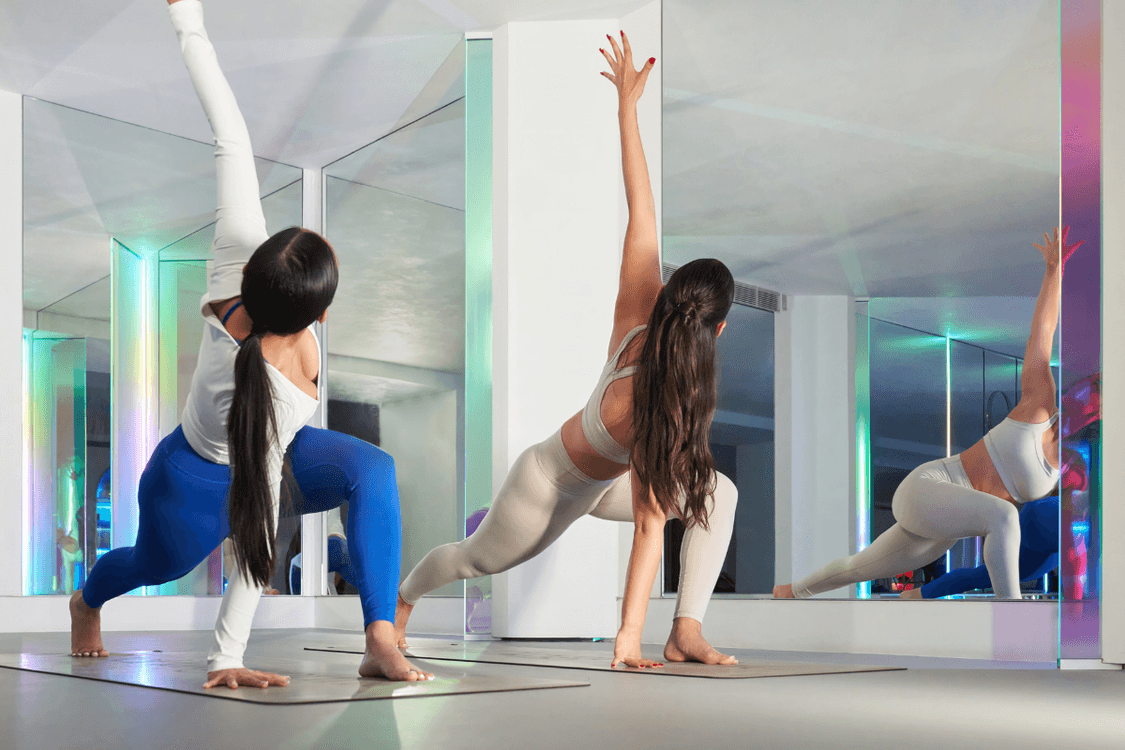
Yoga builds strength differently. Rather than isolating the core, yoga demands strength across your entire body simultaneously. When you hold a plank, a warrior pose, or a handstand, you're recruiting muscles across your shoulders, arms, core, and legs all at once. The strength comes from supporting your bodyweight through space, often in positions that require balance and stability.
Yoga classes build strength in several ways. First, there's the sustained muscular contraction from holding poses. Second, there's the dynamic strength required in transitions between poses, where you're moving your bodyweight with control. Third, there's the postural and balance component, which engages stabiliser muscles throughout your body.
Yoga also tends to develop strength across multiple planes of motion in ways that pure strength training sometimes misses. When you're moving through a flowing sequence, your body has to work in forward, backward, and rotational directions. This builds functional, three-dimensional strength.
The challenge in yoga is that it tends to build more upper-body and full-body strength than deep core stability. Your core will strengthen through yoga, but it's more of a byproduct than the primary focus.
Which One Delivers More Core Strength?
This is one of the most searched questions in this comparison, and the answer is straightforward: Pilates typically delivers more targeted core strengthening.
Pilates was literally designed to strengthen the core. The method places core stability at the centre of every exercise. If deep, functional core strength is your primary goal, Pilates is the more efficient path because it's purpose-built for exactly that.
Yoga will strengthen your core, especially through poses that require significant abdominal engagement like planks and hollow-body holds. But yoga's strength benefits are distributed across your whole body, not concentrated on your stabilising muscles.
That said, this doesn't mean yoga is less valuable for core work. It just means the method develops strength differently, and if core strength is the main goal, Pilates is more directly aligned with that objective.
The Real Value of Each Practice
Beyond pure strength metrics, each practice brings something distinct to your training.
Pilates improves movement quality in measurable ways. The focus on precision and control translates directly into better lifting mechanics if you do strength training. If you're planning to add loaded strength work to your training, Pilates serves as an excellent foundation because your stabiliser muscles will be stronger and more capable of handling load.
Pilates also excels at addressing muscle imbalances. Because the method is so controlled and symmetrical, it helps identify and correct asymmetries in your body. This reduces injury risk and makes your movement patterns more resilient.
Yoga develops something Pilates doesn't emphasise as strongly: full-body integrated strength and dynamic balance. A consistent yoga practice builds the kind of functional strength that translates to athletic performance, agility, and the ability to move confidently in varied situations. Yoga also tends to improve mobility alongside strength, which Pilates supports but doesn't prioritise in the same way.
Yoga's flexibility benefits are genuine too. Because the practice involves sustained stretching alongside strength work, you get both in a single session, which saves time if your goal is balanced development.
Combining Both for Optimal Results
Here's what many people discover after trying both: Pilates and yoga complement each other remarkably well.
Pilates strengthens your stabilising muscles and improves movement quality. Yoga builds full-body, dynamic strength and mobility. Together, they address different aspects of physical development that neither addresses quite as thoroughly alone.
A practical approach might look like using mat Pilates classes or reformer Pilates twice a week to build core stability and postural control, then using yoga classes once or twice a week to develop full-body strength and mobility. If you're also doing structured strength training, this combination gives you a solid foundation from which to build loaded strength more effectively.
Which Practice Is Right for You?
The decision depends on what you're actually trying to achieve.
Choose Pilates if you want to build deep core strength, improve postural control, rehabilitate from injury, or address muscle imbalances. Pilates is exceptionally good at these things, and it's also low impact training, which matters if you need to manage load through your joints.
Choose yoga if you want to build full-body functional strength, improve your balance and spatial awareness, increase mobility alongside strength, or develop the kind of strength that translates to better athletic performance. Yoga is also highly accessible and can be scaled to almost any fitness level.
Choose both if you want balanced development, if you're recovering from injury or managing existing pain, or if you want to build strength while improving flexibility. Many people find that combining the practices keeps them more engaged and motivated over the long term because each session feels different.
Building Real Strength
Neither Pilates nor yoga is a shortcut to strength, and neither will replace structured resistance training if that's your goal. But both practices build genuine, functional strength in specific ways that typical strength training alone doesn't address.
At One Playground, we see people shift their understanding of strength the moment they combine these practices. Pilates students discover that control and precision matter more than intensity. Yoga students realise that strength isn't just about moving heavy things. And people who do both recognise that a truly strong body isn't built from one method alone.
Your mat Pilates classes build core stability. Your yoga classes build dynamic, functional strength. If you add reformer Pilates or choose the right Pilates class for your level, you layer in variable resistance. And if you're doing strengthtraining, all of this supports better lifting mechanics and injury-free progression.
The strongest people aren't the ones who train one way. They're the ones who understand what each method does and use them strategically.
Ready to explore which practice suits you? Come try a class and feel the difference firsthand. Get a free pass and experience both.
More Articles
Spin Classes for Beginners: What to Expect in Your First Ride
New to indoor cycling? Discover what to expect in your first spin class, from bike setup and gear tips to workout structure.
Finding Your Flow: How Often Should You Do Yoga If You Train at the Gym?
Discover how to integrate yoga into your gym routine to improve mobility, accelerate recovery, and boost performance
Pilates for Lower Back Pain and Tight Hips: What to Expect
Discover how Reformer Pilates improves spinal health, core stability, and hip mobility to relieve lower back pain.